
CNC Turning vs Milling: Which Process Fits Your Component?
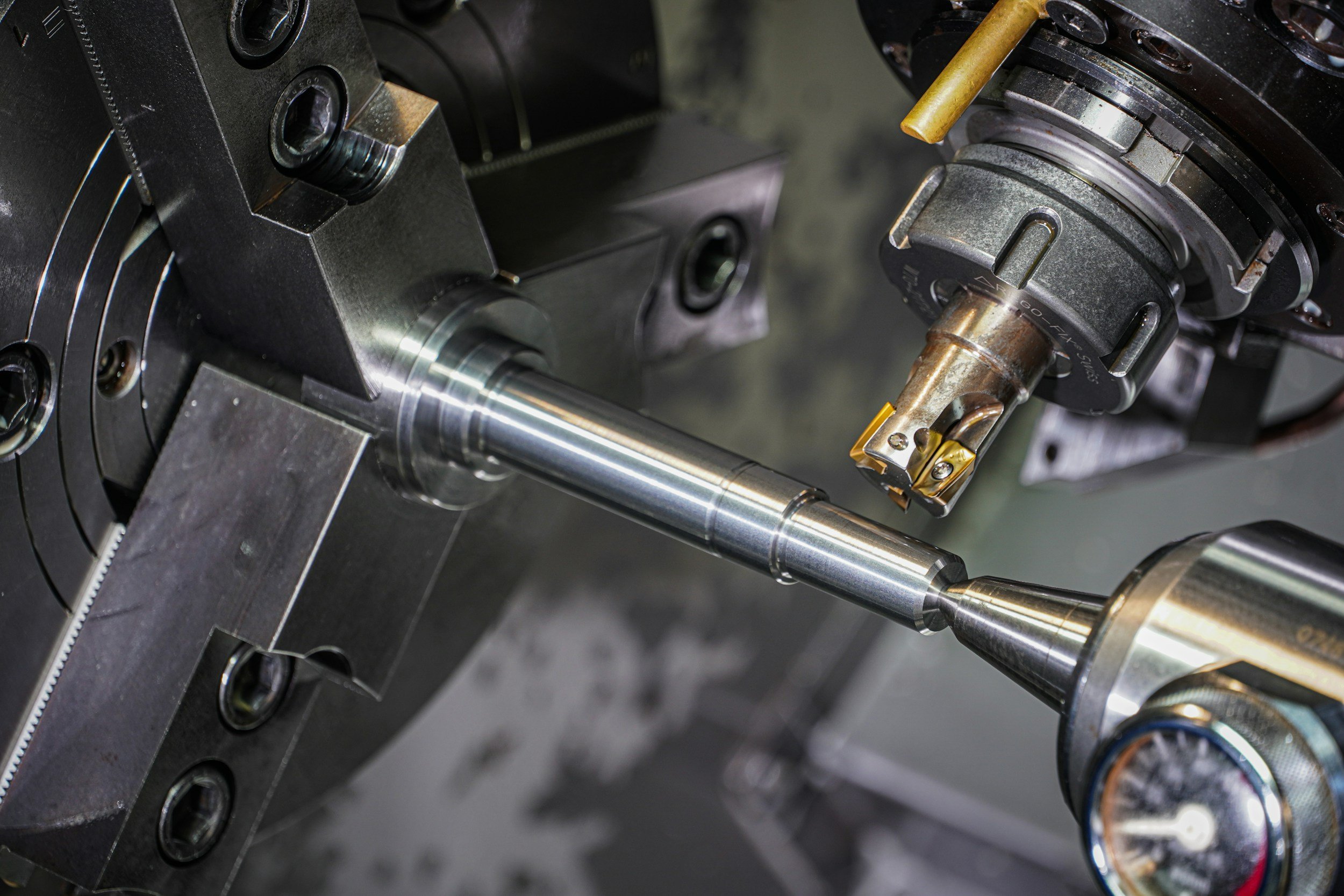
If you're specifying a machined part, this is usually the first fork in the road: does it get turned or milled? Get it wrong and you're either paying for capability you don't need, or asking a process to do something it's not built for. Here's how to make the call.
The core difference
Turning spins the workpiece on a lathe while a fixed cutting tool shapes it. Because everything is referenced off one rotating axis, turning is the natural choice for round, cylindrical, or conical parts - shafts, pins, bushings, spindles.
Milling does the opposite: the workpiece stays still and a rotating cutter moves around it. That's what lets milling produce flat faces, pockets, slots, holes in multiple planes, and irregular shapes that don't have a single axis of symmetry.
Neither process is "better" - they're suited to different geometry. Most components make the decision for you once you look at the shape.
Choose CNC turning if your part is:
Rotationally symmetric: shafts, rollers, bushings, spindles, connectors
Diameter-critical: turning holds roundness and concentricity tighter than milling, because every feature is cut on the same spindle axis
Headed for volume: cycle times on a lathe are typically faster for round geometry once you're past prototype quantities
Threaded: external and internal threads cut on a lathe hold better form and pitch consistency than milled threads
We run our turning work on Doosan Lynx lathes (2100MA, 2600Y, 2600M), with live tooling for jobs that need a secondary operation like a cross-hole or flat without leaving the machine.
Choose CNC milling if your part needs:
Flat faces, pockets, or slots: anything that isn't rotationally symmetric
Features on multiple sides: brackets, housings, plates, manifolds with hole patterns across different faces
Tight positional tolerances between features: true position across faces is a milling strength, thanks to rigid fixturing and probing referenced to one datum
Complex 3D geometry: pockets, contours, and undercuts a lathe simply can't reach
Our milling side runs on Hurco VM1, VM10 and VM30 vertical machines plus a DN Solutions BVM 5700, giving us the travel and Y-axis capability for real 3D work, not just flat facing.
What about parts that need both?
Plenty of components aren't purely round or purely angular - a shaft with a flat milled onto it, a bushing with a cross-drilled hole, a housing with a bored bearing seat. In these cases the two processes are sequential, not competing: the part gets turned first to establish the round features and datums, then milled for anything that needs a flat, a slot, or an off-axis hole. Getting that sequence - and holding the same datum through both operations - right is where experience matters, since a small setup error between operations shows up as a concentricity or position problem in the finished part.
Getting the process choice right the first time
The honest answer for most parts is: the geometry tells you. If you're not sure, send us the drawing — we'll tell you straight whether it's a turning job, a milling job, or needs both, and why, before you commit to a quote.
FAQs
Is turning or milling more accurate?
Turning holds tighter tolerances on round features — roundness, concentricity, diameter. Milling holds tighter tolerances on flatness and positioning across multiple faces. Which is "more accurate" depends on which tolerance your part actually needs.
Which is cheaper, CNC turning or milling?
For simple round parts in higher volumes, turning is usually more cost-effective — shorter cycle times, simpler setup. For complex or low-volume parts, milling tends to work out cheaper overall since it avoids the extra operations a lathe would need to fake non-round features.
Does Evo Precision offer both processes?
Yes. We run CNC turning and CNC milling in-house, along with toolmaking, reverse engineering, and design support — so a part that needs both stays under one roof rather than shipping between shops.
